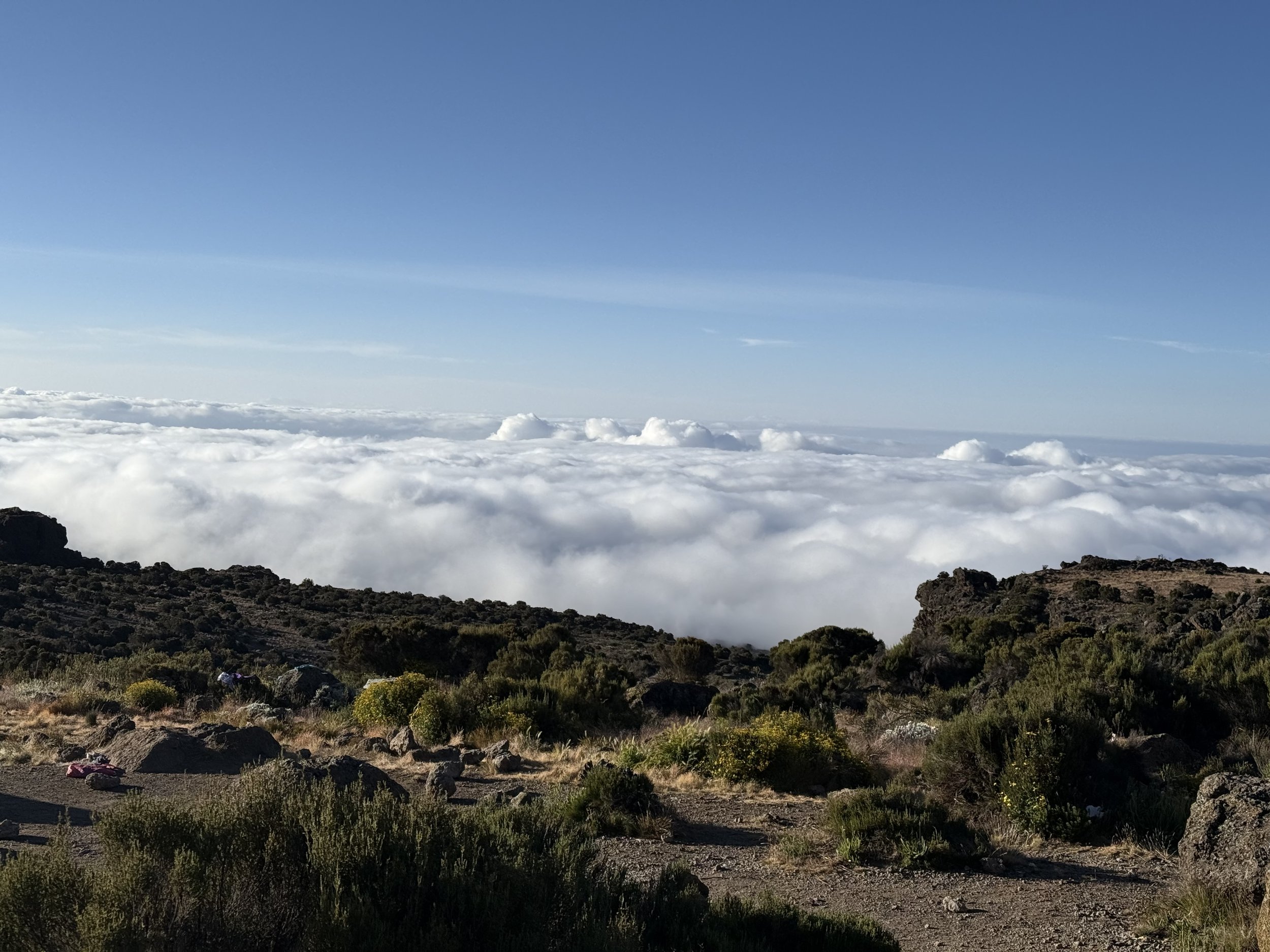
EXPERIENCES
Mt. Kilimanjaro. 19,341 ft.
July 9 - 18, 2027
When the only way forward is slow.
Ten days, including a seven-day ascent of Mt. Kilimanjaro shaped by altitude, effort, and the discipline of moving slowly, built for people who:
Lead at a pace that has quietly stopped producing clear thinking
Want the mountain and the work, and are honest that both are the reason
Are drawn to environments where how you show up matters more than how you perform
Will train for twelve weeks, because a mountain is not negotiable about readiness
Are willing to be uncomfortable, off the grid, and not in charge for a week
The mountain sets the pace
Most leaders are operating in conditions designed for a world that no longer exists.
You optimized for speed. You built systems for efficiency. The environment you built them for is gone.
This is not about escaping that. It is about standing somewhere it cannot follow you.
At altitude, the things that have always worked stop working. You cannot push harder. You cannot think your way through. You cannot perform your way up.
The only technique is going slowly. Pole pole, as every guide on that mountain will tell you in your first hour.
Most leaders have never operated that way.
Seven days of it, and something gives. Not because anyone pushed you toward an answer, but because the conditions stopped letting you avoid one.
Kilimanjaro is not a metaphor. It is a deliberate change of conditions.
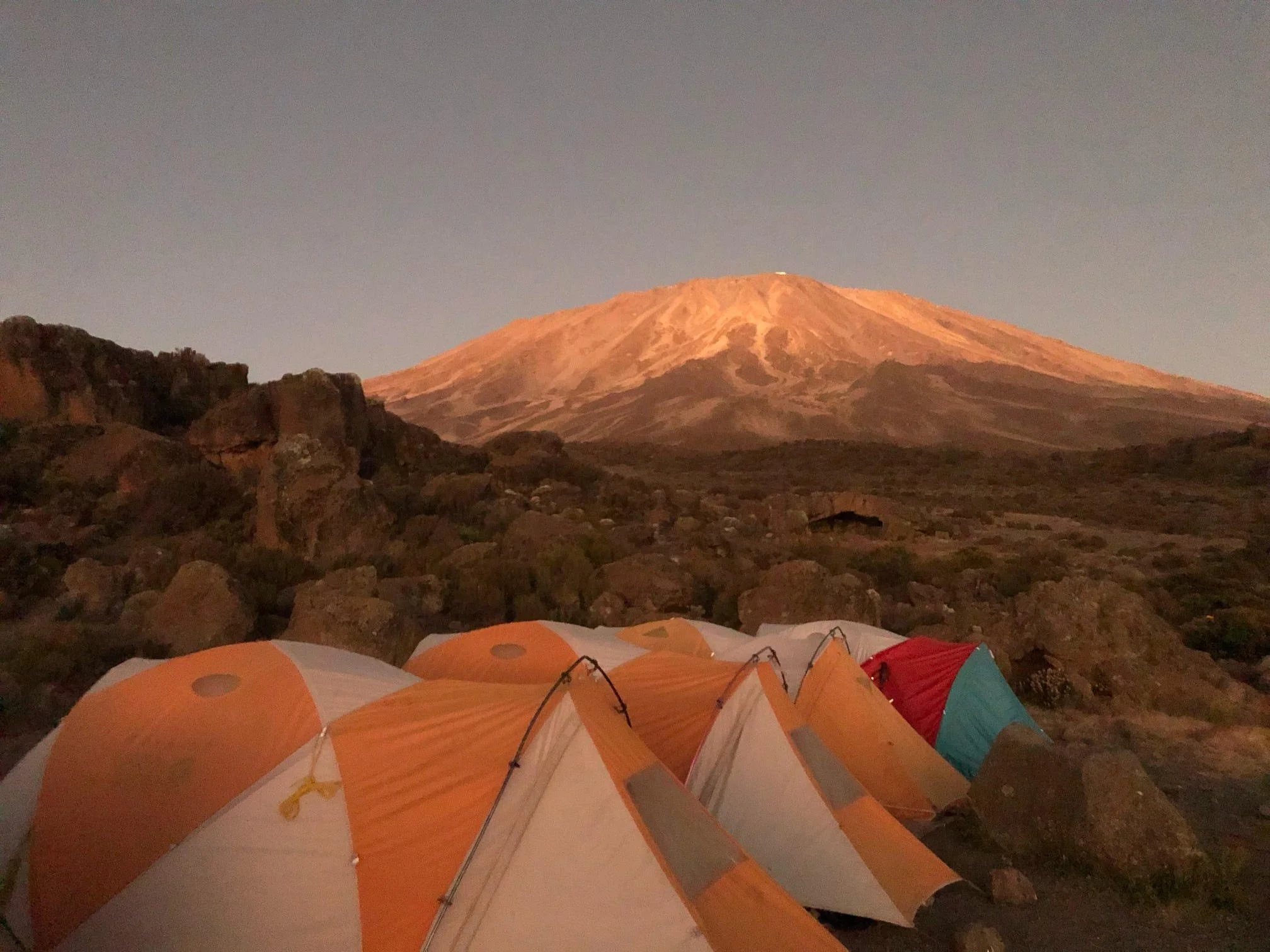
Capacity stops being theoretical
And the decisions that follow are different
Most people arrive carrying something they have not been able to put down at a desk. A decision they keep deferring. A pace they know is not sustainable. A quiet question about whether they still have it.
Seven days at altitude, alongside people carrying questions of their own, changes what is available to your attention. What you've been avoiding can become harder to ignore. What matters can become easier to see.
People leave with:
Proof of what they can do under sustained difficulty
A clearer sense of what they are willing to carry, and what they are not
One or two decisions they came in avoiding, and are now ready to make
Not because anyone pushed them toward answers. Because the mountain removed the conditions that made avoidance possible.
Designed before the mountain, on it, and after you come down.
Before
April to July · twelve weeks
A training plan built for this climb. Cardio, strength, elevation.
Gear and packing guidance for the mountain.
A few pre-expedition conversations to establish context, readiness, and intention.
The Mountain
seven days. 19,341 ft.
Machame Route. Rainforest, moorland, alpine desert, arctic summit.
Short daily debriefs focused on what the conditions reveal.
Time in quiet, with space to notice what becomes clearer away from the usual noise.
After
structured integration
We reconnect after you return, while the experience is still fresh.
A second conversation follows after you have had time to re-enter real life.
The goal is simple: carry forward what matters.
The Experience
-
Day 1 · Friday July 9 · Arrive Arusha
You land at Kilimanjaro International. Someone is waiting at arrivals with your name on a sign. A drive to the hotel. Check in, unpack, breathe.
Day 2 · Saturday July 10 · Arusha
The whole group together for the first time. We walk through the week ahead so nothing on the mountain is a surprise. Health check with the guide team. Gear check, while there is still time to fix something. Welcome dinner, where each of us says what brought us here.
Day 3 · Sunday July 11 · Machame Gate to Machame Camp
We register at the gate and meet the crew. Then you step into the rainforest. Dense canopy, moss-covered trees, colobus monkeys in the branches if you are lucky. The trail climbs steadily but gently. Your body finds its rhythm.
5,400 to 9,800 ft · 5 to 7 hours
Day 4 · Monday July 12 · Machame to Shira
The trees thin and the world opens. Wide volcanic landscape, giant lobelias, groundsels that look like another planet. Tonight you see the summit for the first time. It looks impossibly far. It is not.
9,800 to 12,300 ft · 4 to 6 hours
Day 5 · Tuesday July 13 · Shira to Lava Tower to Barranco
The day that makes or breaks summit success. You ascend to Lava Tower at 15,200 feet for lunch and the altitude will hit you. Slow, heavy, maybe a little nauseous. That is the point. Then you descend to Barranco to sleep lower and wake stronger.
12,300 to 15,200 to 13,000 ft · 6 to 8 hours
Day 6 · Wednesday July 14 · Barranco Wall to Karanga
The day starts with the Barranco Wall, a steep scramble that uses your hands but no ropes, and one of the most exhilarating sections of the route. Crest the ridge, traverse beneath the Southern Glaciers. Karanga is short by design. Rest and hydrate.
13,000 ft · 4 to 5 hours
Day 7 · Thursday July 15 · Karanga to high camp
Base camp for the summit attempt. Barren, windswept, almost no vegetation. Arrive early afternoon. Eat, hydrate, rest. Your guides brief tonight's plan: wake at 11pm, light breakfast, depart by midnight. Try to sleep. You will not sleep much. That is okay.
13,000 to 15,300 ft · 4 to 5 hours
Day 8 · Friday July 16 · Summit · Uhuru Peak, 19,341 ft
Midnight. Headlamps only. Cold air, thin air, one foot in front of the other. Scree and switchbacks. Pole pole. The altitude makes everything harder, breathing, thinking, moving. You keep going.
Stella Point at sunrise. The crater rim, and the sky turning orange, then pink, then gold. You are above the clouds now.
One more hour. One more push. Uhuru Peak, the highest point in Africa. You made it.12 to 15 hours on your feet
Day 9 · Saturday July 17 · Down, and back to Arusha
Closing ceremony with the crew who carried you up and did it with a smile and a lot of song. Final descent through the rainforest to the gate. Your legs are tired, your body is wrecked, you do not care. Sign out. Collect your certificate. Back to Arusha, premium room, hot shower, real bed.
Tonight: the celebration dinner. You stood on the roof of Africa.Day 10 · Sunday July 18 · Recover, and go home
Sleep in. Your body earned it. A spa treatment after breakfast. Then afternoon transfers.
What changed, and what do you take home? That is the work that starts now. -
Seven-day Machame Route expedition with certified Tanzanian outfitters, professional English-speaking guides, a small climber-to-guide ratio, daily health checks, emergency oxygen and a comprehensive medical kit
Led by Tracey, on the mountain, every day. Leading, debriefing, facilitating the work. This is not outsourced
Two nights in Arusha before the climb, so you arrive, rest and prepare
One night in Arusha after, premium room. Hot shower and a real bed when you need them most
Upgraded tents with cots at every camp. Private dining tent. Private toilet tent. You are not sharing facilities with anyone outside our group
A private porter. Your backpack and sleeping gear is carried for you.
All meals and water on the mountain. Chef-prepared breakfast, lunch, dinner and snacks. Unlimited boiled water. Dietary needs honored
Airport transfers, both directions
The twelve-week training program, built for this climb, starting in April
Focused leadership conversations before, during, and after the expedition
A curated gear and packing list
Welcome dinner, summit celebration dinner, and a spa treatment
Mountain crew and all hotel tips
-
International flights
Travel and medical evacuation insurance, required
Tanzania e-visa
Pre-travel medical visit, any necessary vaccinations, altitude and malaria medications
Personal hiking gear
Extra hotel nights
The safari extension
Personal expenses and alcohol
Dates & Logistics
The Climb: July 9 to 18, 2027. Seven days on the mountain.
Dates:
Arusha, Tanzania
Machame Route, Mount Kilimanjaro
Location:
An intentionally small cohort.
Group Size:
A twelve-week training program beginning in April, group sessions before departure, and three months of integration after you return
Preparation:
Questions
YOUR BODY & THE CLIMB
-
Fit enough to walk five to seven hours a day, on consecutive days, carrying a daypack with your daily essentials.
The training program builds exactly that. Cardio, strength, and long hikes with a pack on. Those hikes do not require mountains. I live in Chicago and train on city miles like everyone else. What you are building is the ability to keep walking on tired legs, day after day, which is a different thing from being fit.
Most people who ask this are fitter than they think and less prepared than they need to be. Those are two different problems, and the twelve weeks solves the second one.
What matters more than your fitness today is whether you will do the training. People who train arrive ready. People who intend to train arrive hopeful.
-
You cannot train your way out of altitude risk, and that is worth knowing before you go.
The CDC is clear: physical fitness does not determine your susceptibility to altitude sickness. Individual response varies, and how you have responded to altitude before is one of the better indicators, although even that is not a guarantee.
What we can control is how we approach the mountain.
The seven-day Machame route gives your body more time to acclimatize than a faster ascent. On day five, we climb to 15,200 feet at Lava Tower and descend to approximately 13,000 feet to sleep. We move slowly, monitor how everyone is responding, and adjust when the mountain requires it.
So train hard for the walking. On the mountain, respect the pace, the acclimatization process, and the guidance of the professional guide team.
Before the trip, every participant should also discuss high-altitude travel with their healthcare provider, including whether preventive medication is appropriate for them.
-
No. Kilimanjaro is a trek, not a climb. No technical climbing on the Machame route, no ropes, no harnesses, nothing to learn beforehand.
The Barranco Wall on day six is a steep scramble where you will use your hands. It is the most technical thing you will do all week, and people who are nervous about it are almost always fine once they are on it.
The mountain asks for endurance and patience, not skill. What stops people is altitude and consecutive days. Never technique.
-
Then you do not summit. It happens, and turning around is not weakness.
The seven-day route gives us more time for acclimatization, but altitude does not respect fitness, preparation, or determination. Anyone can reach a point where continuing is no longer the right decision.
If that happens, you will descend with members of the guide team. You are never sent down the mountain alone.
Mountain safety decisions are made by the professional Tanzanian guide team based on your condition and what they are seeing in real time. My role is to stay close to you and the group, help hold the experience together, and make sure what happens next serves both the individual and the cohort.
Turning around does not end your experience. The group, the work, and the three months afterward continue.
Summiting is not the objective. Everyone coming home is.
WHAT’S IT LIKE UP THERE
-
You leave camp at midnight. Headlamps, a line of them ahead of you and behind you, and nothing else visible in any direction.
It is cold, it is dark, and it is slow — scree and switchbacks for six or seven hours, in air with half the oxygen you are used to. Everything is harder. Breathing, thinking, deciding where to put your foot. Most people find it the hardest thing they have ever done physically, and most people also find that the difficulty is not the part they remember.
You reach Stella Point around sunrise, on the crater rim, above the clouds. Then one more hour along the rim to Uhuru Peak, the highest point in Africa.
You are on your feet for twelve to fifteen hours that day. We go pole pole (slowly slowly), and we go together.
-
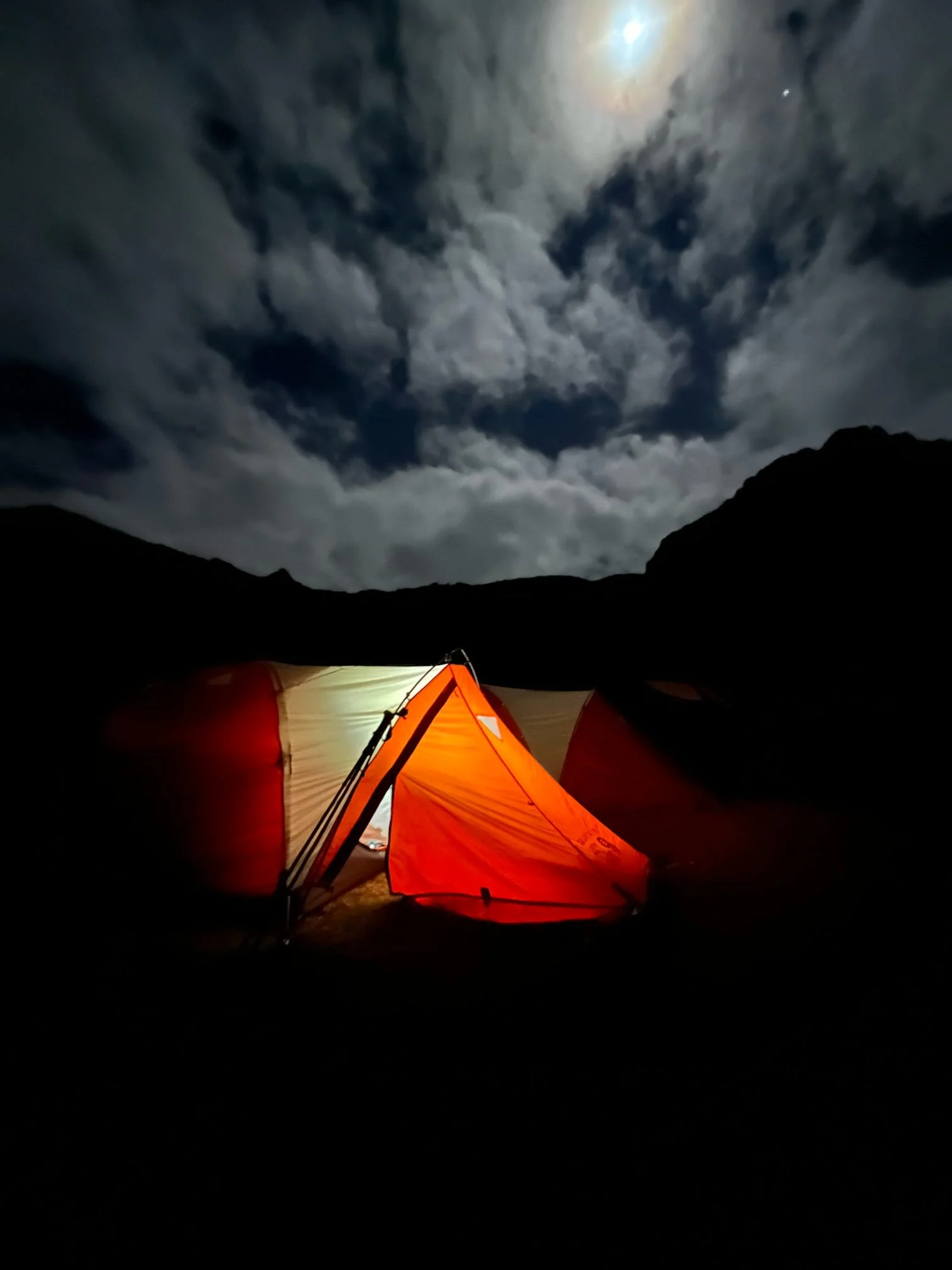
In tents, at a different camp every night. The crew has everything set up before we arrive at every campsite.
We have upgraded tents with cots. A private dining tent and a private toilet tent for our group only, so you are not sharing facilities with other climbers.
It is not a hotel. It is also not roughing it. You will sleep better than you expect on most nights and much less on the night before the summit, which is normal. We’re all in this together.
-
Three chef-prepared meals a day plus snacks, and unlimited boiled water. Most dietary needs are handled; we’ll ask you for these details upon enrollment.
Here is the part nobody warns you about: at altitude your appetite may disappear, usually around day four. Food stops being interesting exactly when your body needs it most.
So eating becomes a discipline rather than a pleasure, we will push you on it. You’ll also drink far more water than feels reasonable. Both of those matter more than fitness in the last three days.
-
At least once daily, we’ll conduct a healthcheck: pulse and oxygen saturation, recorded, so we are watching a trend rather than a moment. Professional guides who do this every week. A small climber-to-guide ratio. Emergency oxygen and a comprehensive medical kit with the team at all times.
The descent plan exists before anyone needs it. That is the point of having one.
And the judgment call is mine, with the guides, made early rather than late. Based on your health, not your pride.
THE GROUP AND THE PROGRAM
-
Deliberately mixed. Leaders, professionals, moms, dads… different industries, different roles, different reasons for coming.
The group will be capped at 12. Everyone has their own tent unless otherwise requested.
The ‘room’ on the mountain is a design decision, not a marketing outcome. I choose it, and I choose for range rather than similarity. The useful conversations on a mountain tend to happen between people who would never have met at a conference.
You will not be the only one who arrived carrying something. Everyone is. Most people find that out on about day three.
-
The training starts at least three months before the climb, and it is a real program I’ve developed and use as well. Cardio, strength, and long hikes with a loaded pack. The training hikes don’t require mountains. I do them in my own city of Chicago, which is under 700 ft. above sea level.
Physical preparation begins twelve weeks out. You’ll follow a structured training plan built for the demands of the mountain, with guidance on strength, cardio, long walks, gear, and travel readiness.
Separately, we’ll have a few focused conversations before departure to establish context and prepare the cohort.
And at least one conversation with me before any of it starts.
-
We reconnect after the expedition to translate what surfaced into decisions, boundaries, or next steps that fit real life. The follow-up is intentionally light. The point is integration, not extending the experience into another program.
-
Yes. It is not an add-on, and there is no version of this that is only the trek.
But it is probably not what you are picturing. There is no sharing circle, no forced vulnerability, nobody asking you to name your feelings in front of strangers. The evening sessions are short and they are about what the day surfaced. What showed up when you hit altitude, when you wanted to stop, when the plan did not survive the conditions. You can be quiet in them. Plenty of people are.
What is required is that you show up. What is not required is that you perform.
And if what you want is only the mountain, there are excellent outfitters who will take you up it. That is a real option, and I would rather you take it than come and resent the evenings.
BOOKING AND GETTING THERE
-
Kilimanjaro International (JRO).
Don't book flights until the expedition is confirmed. I will tell you the moment it is.Transfers are included both directions. Someone will be at arrivals with your name on a sign.
-
Yes. You can apply online through the official Tanzania immigration e-services portal. Processing usually runs one to three business days, but apply well ahead rather than the week before. I've seen this process take 30 days.
-
None are required to enter Tanzania, unless you are arriving from or transiting a country where yellow fever is present, then you need the Yellow Fever vacination certificate. Beyond that it is recommendations, not requirements. See a travel clinic a few months out and they will advise based on your history and your route. Most people also get guidance on malaria and altitude sickness prevention.
-
Travel insurance with emergency evacuation coverage to at least 6,000 meters. This is required, not optional..
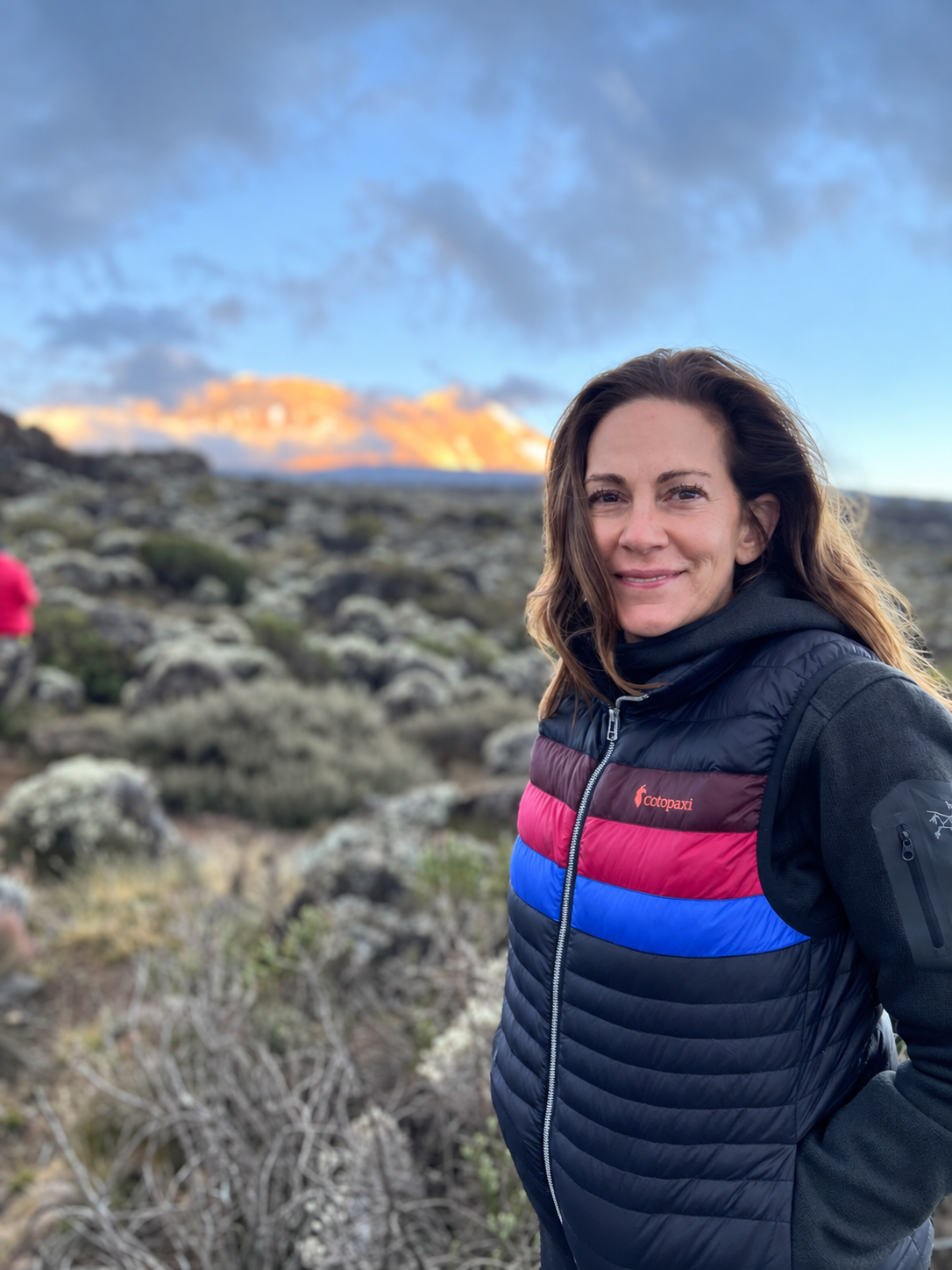
Meet your guide
The rooms where the hardest calls get made are rooms I know from the inside, because I was making some of them. Most of my career was spent at Accenture, where I founded the global unit that defined what the firm sold worldwide.
I've summited Kilimanjaro multiple times, and I've led groups on expeditions across four continents. I'm NOLS Wilderness First Aid and CPR/AED certified. Leading is a different job from climbing, and it's the one that matters when you're the person being led.
My job on the mountain is steady presence and clear structure. Not steering. You do your own thinking. I build the conditions that let it happen.
The next step is a conversation.
A short conversation is the best way to determine fit.